
Prevention By Design:People, Process & Technology
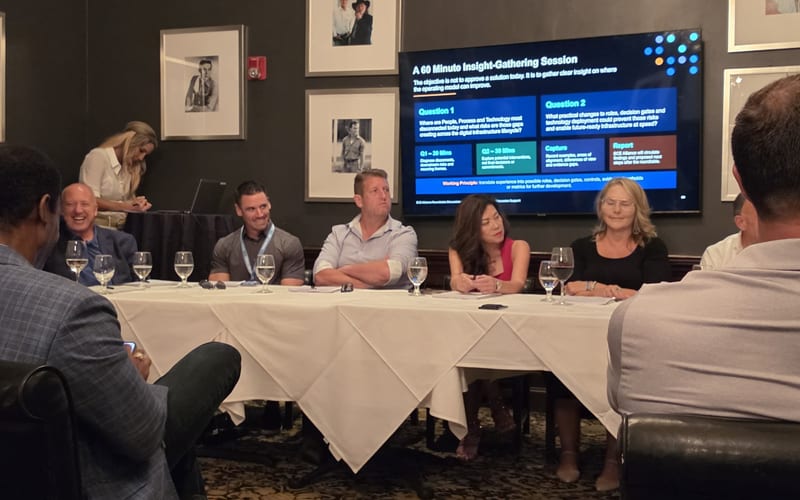
BCE Alliance's second Roundtable Discussion took place in Austin, Texas, bringing together 9 senior leaders from across the mission critical supply chain to continue the conversation started in London.
In London, we asked where value, information and accountability get lost between organisations. In Austin, we widened the lens. The question this time was simple to ask and hard to answer: how must people, process and technology work differently to build infrastructure that is resilient, responsible and future-ready?
The room did not land on a tidy answer. What it landed on was something more useful: a shared picture of where the risk actually sits. Not inside any single discipline, but in the gaps between them. Between design and procurement. Between specialist systems and base build. Between construction and operations. Between a commercial decision and the technical outcome nobody notices until years later.
"The risk doesn't sit inside any single discipline. It sits in the gaps between them."
A Sector Growing Faster Than It Can Staff Itself
The conversation kept returning to people before it returned to technology. Data centre growth is outpacing the workforce that has to deliver it. Inexperienced teams are increasingly handed complex, mission critical scopes under real schedule pressure, while the most experienced professionals are recruited away almost as soon as they are found. One figure raised in the room — a shortfall of 500,000 people by 2030 — was treated less as a statistic and more as a warning.
This is not only a resourcing problem. It is a capability problem. When experience leaves a project faster than knowledge can be transferred, complex decisions end up in the hands of people who have not yet seen the full consequence of getting them wrong.
Process Still Rewards the Wrong Thing
A second pattern ran just as deep. Specialist systems such as heat tracing, leak detection and monitoring are still too often poorly understood at the engineering stage, then pushed downstream into delegated design or resolved on site. Procurement makes it worse. Traditional bid levelling can quietly discourage a bidder from challenging a specification, even one that is technically unnecessary, because a qualified alternative risks being marked non-compliant rather than welcomed.
The group's own example was blunt: a roof and gutter de-icing system specified for Phoenix, Arizona, carried forward through a process built to reward compliance over judgement. Nobody in the room thought that was a one-off.
Technology Is Arriving Before Operations Are Ready
Liquid cooling and AI infrastructure are moving into facilities faster than the operating models built to support them. Equipment and thermal systems are reaching site before procedures exist for testing, maintenance, fluid response or escalation. The risk, participants were clear, is not the technology itself. It is a lifecycle approach that still gets added after deployment, instead of designed in from the start.
From Conversation to Mechanism
What distinguished Austin from a general industry discussion was its insistence on mechanisms, not good intentions. Participants pointed to the Toyota Andon cord — the principle that anyone on a production line can stop and escalate when they see a problem. Nobody suggested pausing a data centre build. What they wanted was the same confidence: a safe, structured way to raise a concern before it becomes a defect, an incident, or an expensive piece of rework.
That same instinct shaped the room's recommendations for the wider industry: common design assurance checkpoints from concept through handover, a shared minimum information set across disciplines, coordinated technical review before key procurement decisions, stronger controls on substitution, and a genuine feedback loop so that commissioning findings and maintenance experience actually reach the next design.
What This Means for BCE Alliance
London and Austin were never meant to produce a finished framework in two sessions. They were meant to test whether the same pattern holds as the lens widens — from supply chain collaboration to people, process and technology globally. It does.
The next phase of this work moves from conversation to implementation: a shared Prevention by Design charter, and a cross-functional group able to turn recurring risks into practical guidance, checklists, handoff protocols and procurement language that the sector can actually use.
If the sector is going to build at the speed and scale now being asked of it, prevention cannot stay a late-stage quality check. It has to become part of how resilient, responsible, future-ready infrastructure is designed and delivered — globally, not just locally.
BCE Alliance is exploring a Global Data Centre Tiger Team — an early-stage, cross-disciplinary forum for owner-operators, consultants, contractors and specialist manufacturers who want to help build the practical, internationally relevant approaches this moment calls for. If that is you, we would like to hear from you.
Full Report
Download the Full ReportShare this article
Join the conversation.
BCE Alliance brings together leaders across critical infrastructure to share knowledge, build confidence, and shape the future of the industry.